

Last Updated: 14 August 2026
L-Shape Sofa Malaysia Buying Guide: 6 Things to Check Before You Buy
An L-shape sofa can provide generous seating, create a comfortable place to stretch out and help define the living area in an open-plan home. However, its extended section also takes up more floor space and determines how people move through the room. Choosing the correct size and orientation matters as much as choosing the colour.
Before buying an L-shape sofa in Malaysia, measure the room and delivery route, confirm whether you need a left- or right-facing layout, calculate the seating you actually need, compare configurations and features, test the comfort and materials, and review the complete cost, warranty and return terms. The best model is the one that fits your layout in everyday use—not simply the sofa with the most seats.
This guide explains those six decisions and gives you a practical checklist for apartments, condominiums and landed homes.
What is an L-shape sofa?
An L-shape sofa is a seating arrangement with two sections meeting at an angle. One side is usually longer or deeper, creating an “L” footprint. Depending on the design, the extended section may be a chaise, a corner section, a recliner or a combination of modular units.
The terms used by retailers can overlap:
| Term | Typical meaning | What to verify |
|---|---|---|
| L-shape sofa | General term for a sofa with an L-shaped footprint | Overall width, return depth and orientation |
| Sectional sofa | A sofa made from two or more connected sections | Whether sections can be rearranged or only assembled one way |
| Corner sofa | A sofa designed to turn through a corner | Corner position, seat count and total dimensions |
| Sofa with chaise | A sofa with one long seat for stretching out | Which side the chaise occupies and whether it can move |
| Modular sofa | Individual units that can be combined in different layouts | Included modules, connectors and permitted arrangements |
Do not choose by the product name alone. Read the diagram, component list and dimensions for the exact model.
Is an L-shape sofa right for your living room?
An L-shape sofa is usually a strong choice when you want to maximise seating along two directions, use an empty corner or visually separate the living area from a dining space. A straight sofa may be more practical when the room is narrow, access is difficult or you rearrange the furniture frequently.
| An L-shape sofa may suit you if… | Consider a straight or modular alternative if… |
| You have a clear corner or open-plan zone | The extended section would block a doorway or main walkway |
| Several people lounge together regularly | You need furniture that moves easily between rooms |
| You want a built-in place to stretch out | You prefer separate seats that can face one another |
| Your layout has a permanent left or right orientation | You expect to move home or reverse the layout soon |
| You have confirmed the delivery route | Your lift, stairwell or entrance has restricted access |
Quick answer: which L-shape configuration should you shortlist?
| Your priority | Suitable starting point | Check before buying |
| Compact everyday seating | Smaller sofa with chaise | Total width, chaise depth and walkway clearance |
| Flexible future layouts | Reversible or modular sectional | Whether the chaise can genuinely switch sides |
| Family lounging | Deeper multi-seat sectional | Seat depth, cushion support and cleaning needs |
| Watching television | Reclining sectional | Open depth, wall clearance and power access |
| A tailored finish | Made-to-order sectional | Lead time, final orientation and return restrictions |
| Premium natural finish | Leather sectional | Leather type, care instructions and room conditions |
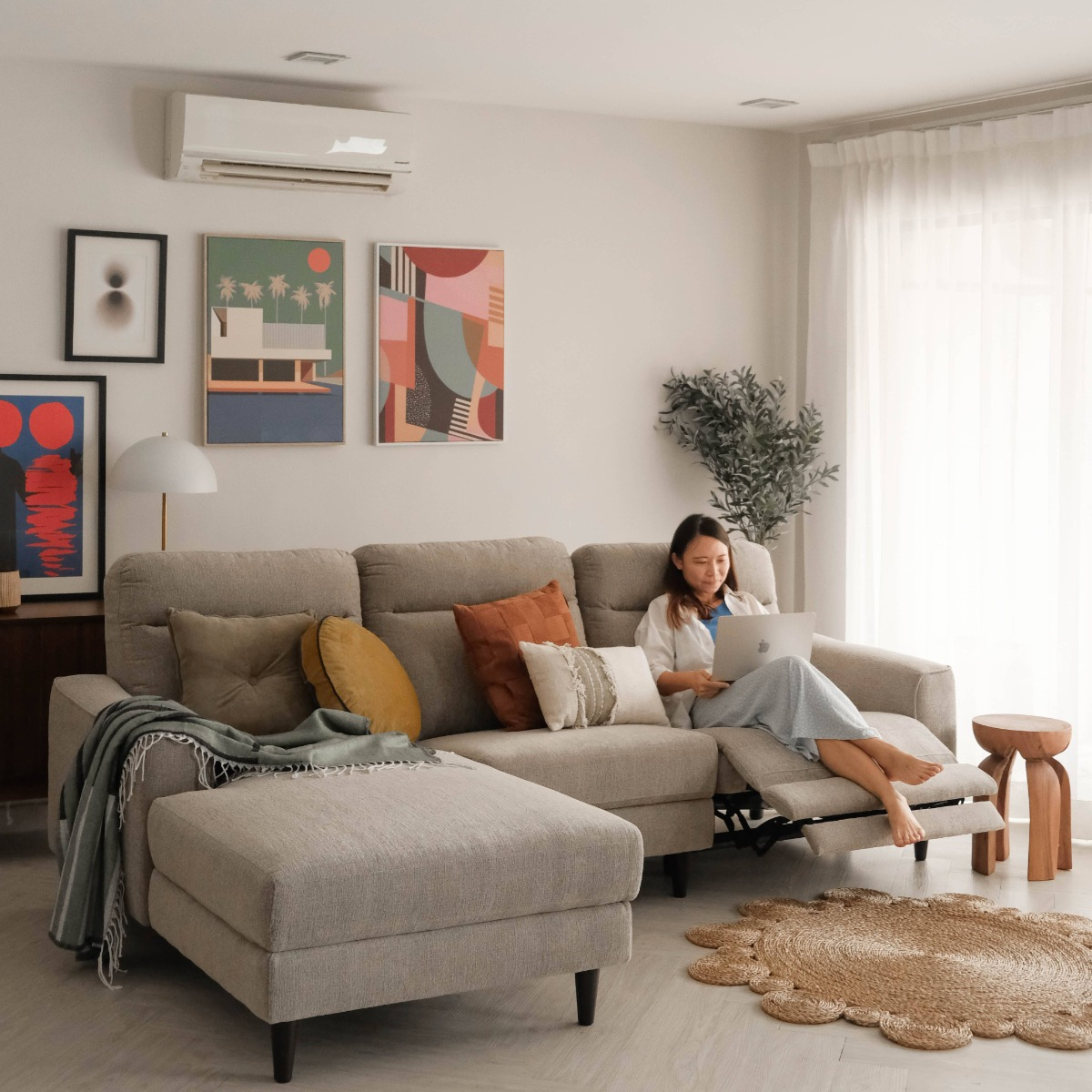
1. Measure the room and the complete delivery route
Start with the final position, but do not stop there. A large sofa must also travel through the building and into the room.
Which sofa measurements matter?
-
Overall width: the longest horizontal measurement across the sofa.
-
Standard depth: how far the main seats project into the room.
-
Chaise or return depth: how far the extended section projects.
-
Overall height: important near windows, wall features and low shelves.
-
Seat height and depth: affect comfort and ease of standing.
-
Open depth: required for reclining sections or adjustable components.
-
Packaged dimensions: determine whether each carton or section can pass through the delivery route.
L-shape measurements are often written in a format such as width × standard depth/chaise depth × height. Always check the diagram because the order and description can vary between product pages.
How do you check whether an L-shape sofa will fit?
-
Measure the wall and floor area where the sofa will sit.
-
Mark the full footprint with masking tape, including the chaise.
-
Open nearby doors, balcony doors, drawers and cabinets.
-
Walk through the room using your normal routes.
-
Add the intended coffee table, side table and TV cabinet to the taped plan.
-
Measure the entrance, corridors, corners, stairwell and lift.
-
Compare the narrowest access point with the packaged sections—not only the assembled sofa.
As a planning starting point, many people find approximately 40–45 cm between a sofa and coffee table comfortable, while a main walkway may need roughly 75–90 cm. These are practical guidelines rather than universal rules; adjust them for your room, household and mobility requirements.
Why does delivery access need separate measurements?
A sofa that fits the living room may still be impossible to turn through a corridor or lift entrance. Measure:
-
Door and lift opening width and height
-
Lift interior width, depth and height
-
Corridor width and turning space
-
Stair width, landings and ceiling height
-
Gates, railings and removable door obstructions
If access is tight, ask whether the sofa arrives in separate sections, whether legs or arms detach, and what the largest packaged piece measures.
2. Choose the correct left- or right-facing orientation
Orientation is one of the most important and frequently misunderstood decisions. It determines where the chaise or return will sit once the sofa is assembled.
What is a left-facing or right-facing sectional sofa?
The definition can depend on whether the retailer describes the sofa while you are standing in front of it or sitting on it. Because naming conventions are not universal, never rely on the words “left” and “right” without checking the product image or layout diagram.
Before ordering:
-
Stand in the room facing the future sofa position.
-
Identify the side that must remain open for movement.
-
Note windows, doors, balcony access and the TV position.
-
Match your plan with the product diagram.
-
Ask the retailer to confirm the orientation in writing if anything is unclear.
Where should the chaise go?
Place the chaise where it will not cut across the main route into the room. In a corner layout, the extended section may work best along the wall. In an open-plan layout, it can help mark the edge of the living zone—but only if there is enough circulation space around it.
Think about daily movement, not just the empty room. A layout that looks balanced in a floor plan may become inconvenient once people, tables and doors are added.
Should you choose a reversible or modular sofa?
A reversible chaise or modular sectional can offer more flexibility if you rent, expect to move or like rearranging the room. Confirm exactly what “reversible” means. Some sofas allow the chaise cushion or ottoman to change sides; others require different components and cannot be reversed after purchase.
3. Match the seating capacity to your household
Seat count is helpful, but it does not tell the whole story. Cushion width, arm size, chaise design and individual sitting preferences affect how many people can use the sofa comfortably.
Ask:
-
How many people use the sofa every day?
-
How often do you host guests?
-
Does anyone prefer lying down rather than sitting upright?
-
Will children or pets share the seating area?
-
Do you need everyone to face the television?
-
Would a smaller sofa plus a lounge chair create better conversations?
Is a bigger L-shape sofa always better?
No. Extra seats are useful only if the sofa still leaves space for movement and other essential furniture. An oversized sectional can dominate a small room, restrict the route to the balcony or force the coffee table too far away.
For a smaller household, a compact L-shape sofa or straight sofa with an occasional chair may offer more flexibility. For a larger family that lounges together, a wider sectional may make good use of the available floor area.
Can an L-shape sofa work in a small living room?
Yes, when its dimensions and orientation suit the room. A compact chaise can use a corner efficiently and provide lounging space without adding a separate ottoman. However, “L-shape” does not automatically mean space-saving. Some models are wide, deep and designed for generous rooms.
For a compact room, look for:
-
A controlled overall width and chaise depth
-
Slimmer arms
-
A raised base or visible legs for a lighter appearance
-
A chaise that follows the room's least-used edge
-
A lower visual profile, provided the back remains comfortable
-
Enough clearance for doors and main walkways
4. Compare the configuration and useful features
Once the size and orientation are clear, decide which configuration supports your routine. Added features can improve comfort, but they also affect price, weight, clearance and maintenance.
Fixed chaise sectional
A fixed chaise creates a simple place to stretch out and generally has fewer moving components. It suits a stable layout where you are confident about the left or right orientation.
Modular sectional
A modular sofa uses separate units that can be combined. It may be easier to deliver and reconfigure, depending on the design. Check how modules connect and whether every pictured layout is possible with the components included in the listed price.
Reclining sectional
A reclining L-shape sofa offers adjustable comfort for television viewing or relaxation. Measure the sofa when open and check the mechanism, power access, control position and warranty coverage. A recliner needs more operating clearance than its closed dimensions suggest.
Adjustable-headrest or adjustable-back sofa
Adjustable components let different users change their support or sitting angle. Test each position, especially if the sofa will sit below a window or near a wall.
Sofa with integrated side table, storage or charging
Built-in features may reduce the need for separate furniture, but they can also make the sofa wider or lock you into a particular arrangement. Confirm access to sockets and consider whether the feature will remain useful if the layout changes.
5. Test the comfort, upholstery and construction
An L-shape sofa is often used for several hours at a time, so surface softness is only one part of comfort.
What should you test in a showroom?
-
Sit upright with your feet on the floor.
-
Check whether the seat edge presses behind your knees.
-
Lean back and notice whether your lower and upper back feel supported.
-
Try the chaise in your usual lounging position.
-
Sit beside another person to judge usable seat width.
-
Stand up without pulling heavily on the arms.
-
Test reclining or adjustable parts through their full range.
-
Move between sections and check whether comfort is consistent.
People have different body proportions and preferences. A sofa described as soft, medium or firm may still feel different to each user, so showroom testing is valuable when possible.
Which sofa material suits a Malaysian home?
| Material | Strengths | Considerations |
| Woven fabric | Comfortable, versatile and available in many colours | Cleaning method and stain visibility vary by fabric |
| Textured fabric or velvet | Creates depth and a tactile, decorative finish | Texture may hold dust or require more attentive care |
| Leather-look upholstery | Smooth appearance and generally easy to wipe | Follow the specified care method and avoid unsuitable cleaners |
| Natural leather | Distinctive appearance that develops character with use | Requires appropriate maintenance and protection from heat and direct sunlight |
| Water-repellent or easy-care fabric | Helpful for active households and light spills | Not stain-proof; spills should still be treated promptly |
Malaysia's warm, humid conditions make ventilation and maintenance important. Keep the sofa away from persistent dampness, allow air to circulate and follow the care instructions for the exact upholstery.
What quality details should you check?
-
Frame and leg materials
-
Seat and back cushion construction
-
Suspension or spring information
-
Stitching, seams and upholstery alignment
-
Stability where sectional components connect
-
Smooth movement of recliners or adjustable backs
-
Fixed versus removable cushion covers
-
Product-specific care instructions
-
Product-specific warranty coverage
Do not assume that every component has the same warranty period. Frame, mechanism and other parts may have different coverage.
6. Calculate the complete cost and review the terms
The purchase price is only one part of the decision. Compare what is included and what may add cost later.
Your checklist should cover:
-
Sofa price and chosen upholstery
-
Additional modules or upgraded fabrics
-
Delivery to your postcode
-
Assembly or installation
-
Removal of existing furniture, if needed
-
Lead time for ready-made, preorder or made-to-order items
-
Care products or professional cleaning
-
Warranty duration and exclusions
-
Exchange, return and collection fees
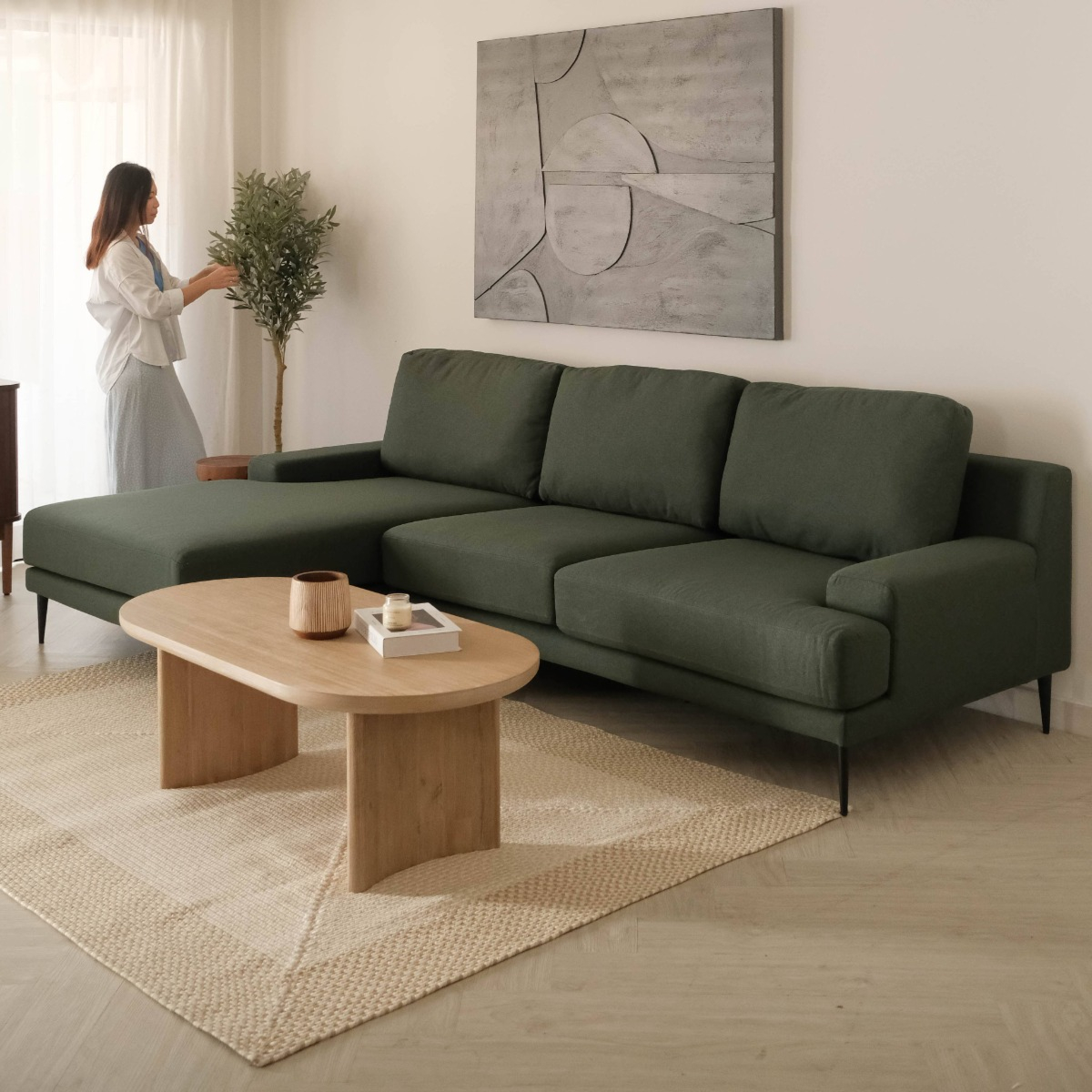
What should you know about Ruma's sofa warranty?
At the time of this update, Ruma's warranty page states that for orders placed from 1 May 2026, made-to-order sofa frame structures carry a five-year limited warranty, ready-made sofa frame structures carry a three-year limited warranty, reclining mechanisms carry a three-year limited warranty, and specified other sofa components carry a 365-day limited warranty. Coverage is subject to the complete terms, exclusions and claim requirements.
Always read the current product warranty and the exact product page before ordering, as terms may change and different components can have different coverage.
Can you return an L-shape sofa if it does not fit?
Ruma's current 14-Day Satisfaction Guarantee allows qualifying furniture exchanges or returns within 14 days of delivery, subject to item condition, packaging requirements, exclusions and applicable fees. Made-to-order or custom-made items are excluded, and the guarantee is not applicable to deliveries to East Malaysia under the current terms.
Measure carefully rather than treating returns as a substitute for planning. Review the latest satisfaction guarantee before purchasing.
How do you arrange an L-shape sofa?
Against a corner
This layout uses two adjoining walls and keeps the centre of the room more open. Check that the back does not cover power points, curtains or access panels.
Floating in an open-plan room
The back of the sofa can define the living zone without a wall. Keep the main route between the living and dining areas clear, and consider how the sofa looks from behind.
Facing a television
Position the main seats toward the screen and check whether the chaise gives a comfortable viewing angle. Avoid placing the extended section across the route to the television cabinet or balcony.
Beside a window
Check the sofa height against the window, curtains and airflow. Protect the upholstery from prolonged direct sunlight according to its care requirements.
What should you pair with an L-shape sofa?
Coffee table
Choose a table that is accessible from the main seats without obstructing the chaise. Round or oval tables can soften a compact arrangement, while a rectangular table may suit a longer sofa. Mark the table on the floor plan before deciding.
Side table
A side table near the open end of the sofa provides a convenient surface without filling the area in front of the chaise. Browse side and accent tables and compare their height with the sofa arm.
Rug
A rug can visually connect the sectional with the rest of the room. As a starting point, select one large enough for at least the front legs of the main seating sections to sit on it rather than using a small rug that appears disconnected.
Lounge chair or pouf
An occasional chair can improve face-to-face conversation, while a pouf can provide flexible seating. Make sure the additional piece does not close the main walkway.
Current L-shape options at Ruma Home
Ruma's current L-shape sofa collection includes compact and spacious sectionals, left- and right-facing versions, curved chaise designs, adjustable backs, power-reclining models, fabric choices and made-to-order options.
Use the filters and product specifications to compare:
-
Overall width and chaise depth
-
Left or right orientation
-
Seat height
-
Ready-made, preorder or made-to-order status
-
Upholstery and available colours
-
Reclining or adjustable features
-
Assembly and packaged dimensions
-
Warranty details
Prices, products, lead times and availability can change, so this guide deliberately avoids listing time-sensitive prices. Confirm the latest details on the product page.
Common L-shape sofa buying mistakes
Confusing left and right orientation
Retailer conventions can differ. Use the product diagram and written confirmation instead of assuming what “left-facing” means.
Measuring only the longest wall
The chaise depth, doors, walkways and other furniture also determine whether the sofa fits.
Forgetting the lift and corridor
Room measurements do not prove that the packaged sections can reach the room.
Assuming all sectional sofas are modular
Some models arrive in sections for delivery but still assemble in only one fixed arrangement.
Not testing every seat
The corner, chaise and main seats may feel different. Try the positions your household will actually use.
Choosing features without planning their clearance
Recliners and adjustable backs may need additional space and power access.
Ignoring made-to-order restrictions
Custom selections can have longer lead times and different cancellation, exchange or return conditions.
L-shape sofa buying checklist
Before placing your order, confirm:
-
The sofa footprint has been marked on the floor.
-
Doors, drawers and walkways remain usable.
-
The delivery route and packaged sections have been measured.
-
The left- or right-facing orientation matches the room.
-
The sofa provides enough practical seating for the household.
-
The chaise, corner or modular configuration suits daily use.
-
Reclining and adjustable components have enough clearance.
-
The seat height, depth and support feel comfortable.
-
The upholstery and cleaning requirements suit the household.
-
The construction and component warranty have been checked.
-
Delivery, assembly, lead time and total cost are understood.
-
Current return and exchange restrictions have been reviewed.
Find the right L-shape sofa for your Malaysian home
The right L-shape sofa should make your living room easier to use. It should offer comfortable seating without blocking circulation, place the chaise on the correct side and suit the way your household relaxes.
Measure first, confirm the orientation, and then compare seating, features, comfort, materials and total cost. Those six checks will narrow the choice far more effectively than selecting by colour or seat count alone.
Explore Ruma's current L-shape sofa collection and review the dimensions, orientation and specifications of each model before deciding.
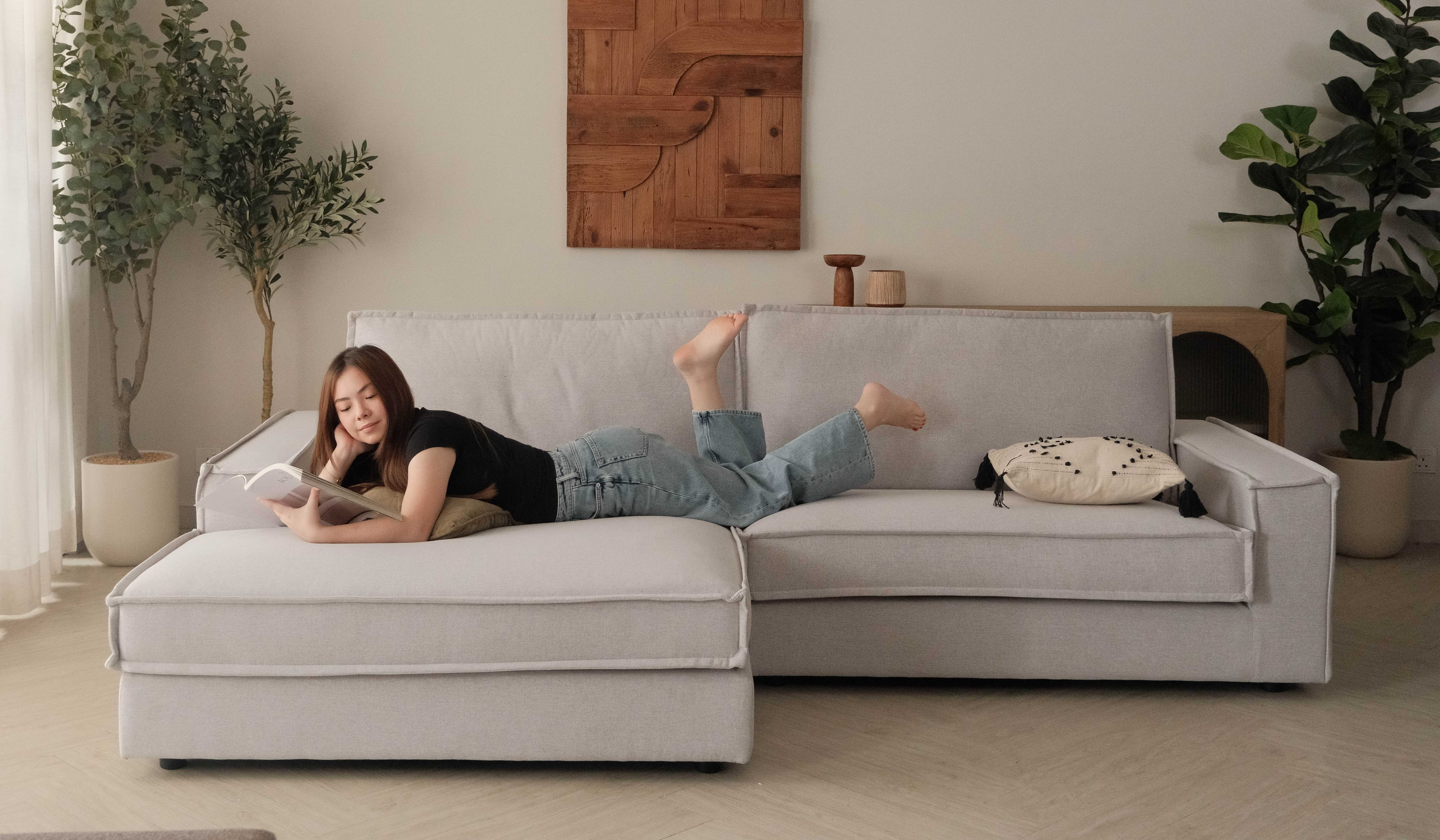
Frequently asked questions
What should I consider before buying an L-shape sofa?
Measure the room and delivery route, confirm the left- or right-facing orientation, calculate the seating you need, compare configurations and features, test comfort and materials, and review the complete cost, warranty and return terms.
Is an L-shape sofa suitable for a small living room?
It can be, provided the overall width and chaise depth fit without blocking doors or walkways. A compact chaise may use a corner efficiently, but an L-shape sofa is not automatically smaller than a straight sofa. Always compare actual dimensions.
What is the difference between a left- and right-facing L-shape sofa?
The terms indicate which side contains the chaise or extended section. Because retailers may describe orientation from different viewpoints, confirm it using the product diagram rather than the name alone.
How do I measure a room for an L-shape sofa?
Measure the available width, standard depth and chaise depth, then mark the entire footprint on the floor. Check doors, walkways and surrounding furniture. Separately measure every doorway, corridor, turn, staircase and lift on the delivery route.
Is an L-shape sofa better than a normal sofa?
Neither is universally better. An L-shape sofa offers integrated lounging and can maximise seating in a suitable corner or open-plan zone. A straight sofa is often easier to position, move and pair with separate chairs. The room layout and household routine should decide.
What is the difference between an L-shape sofa and a sectional sofa?
An L-shape sofa describes the final footprint. A sectional sofa is made from multiple connected sections and may form an L shape. Some sectionals are modular and reconfigurable, while others have a fixed arrangement.
Which material is suitable for an L-shape sofa in Malaysia?
The best material depends on cleaning needs, comfort and appearance. Fabric offers broad colour and texture choices, leather-look upholstery is generally easy to wipe, and natural leather requires appropriate care. Follow the exact product's care instructions and maintain good ventilation.
How many people can sit on an L-shape sofa?
Capacity varies by model. Do not rely only on a “3-seater” or “5-seater” label; check usable seat width, cushion divisions and chaise design. Sit together in the showroom where possible.
Can an L-shape sofa be reversed?
Only if the product is specifically designed with a reversible chaise or modular arrangement. Many left- and right-facing sectionals have a fixed orientation and cannot be reversed after purchase.
Can I return a Ruma L-shape sofa if it does not fit?
Qualifying furniture may be exchanged or returned under Ruma's current 14-Day Satisfaction Guarantee, subject to item condition, packaging requirements, exclusions and fees. Made-to-order or custom-made items are excluded, and the current guarantee does not apply to East Malaysia deliveries. Check the latest terms before ordering.
Reviewed by the RUMA Editorial Team
The RUMA Editorial Team reviews home and furniture content to help readers make clearer buying decisions based on space, function, and everyday living needs.
